

Introduction
Walk into any Indian kitchen and you will find at least one piece of aluminium bartan on the shelf. The big patila that makes dal for twenty guests, the deep kadai that handles pakoras and sabzi, the small tapeli for the daily tadka: aluminium has been part of Indian cooking for generations, and for good reason. It is light, it heats quickly, and it costs far less than most other metals.
But not every piece is equal. Two kadais that look identical on the shelf can behave completely differently on your stove: one cooks evenly for ten years, the other warps, burns food at the centre and develops dents within a season. The difference lies in details that most buyers never check.
This guide walks you through exactly what to look for before you buy aluminium bartan, with specific attention to the aluminium patila and the aluminium kadai, the two pieces most households reach for every single day.
Why Aluminium Bartan Still Makes Sense for Indian Kitchens
Aluminium is an excellent conductor of heat. That means your food starts cooking almost as soon as the flame is lit, which saves gas and time. For everyday cooking such as boiling milk, making rice, preparing dal or frying snacks, a good piece of aluminium bartan performs very well.
It is also light. A large aluminium patila can be lifted and tilted by one person even when full, which matters if you cook in bulk for festivals, functions or a large joint family. Steel and cast iron of the same size would be considerably heavier.
The trade-off is that aluminium is a softer, more reactive metal. It dents more easily than steel and it does not suit every kind of recipe. Knowing that up front helps you buy the right piece and use it the right way.
How to buy Aluminium Bartan
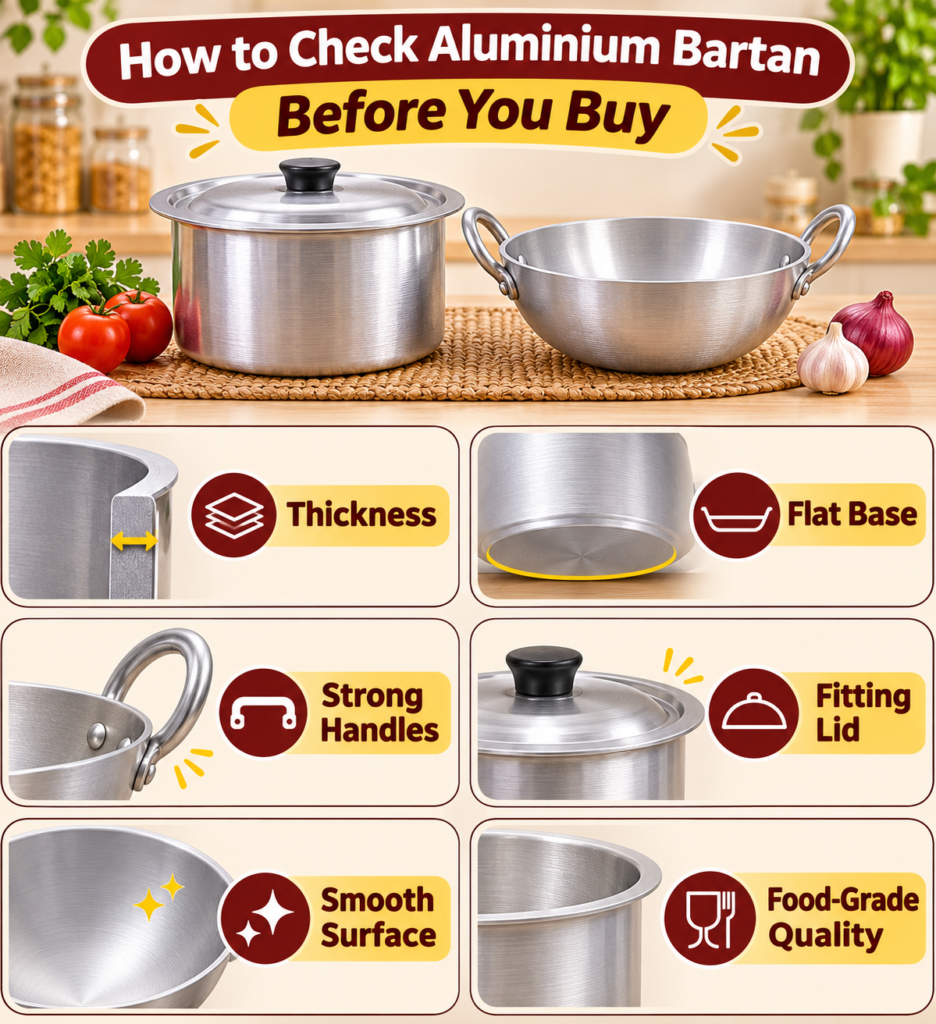
Check the Thickness First
Thickness (gauge) is the single most important quality indicator in any aluminium bartan. Thin, flimsy vessels heat unevenly, create hot spots and warp when exposed to high flame. Thick, well-made ones spread heat steadily and last far longer.
When buying aluminium bartan for regular kitchen use, checking the thickness helps you distinguish a sturdy vessel from one that may bend or warp with frequent cooking.
Here is a quick, practical way to judge it in the shop or when your parcel arrives:
- Press the side wall with your thumb. It should feel firm, not springy or hollow.
- Look at the rim. A thicker rim that has been rolled or reinforced is a good sign.
- Tap the base. A dull, solid sound suggests a heavy base; a tinny, ringing sound usually means thin metal.
- Compare weight. Two vessels of the same size and shape should not feel wildly different. A suspiciously light aluminium kadai is often a thin one.
As a rough guide, a kadai meant for regular frying and sautéing should have a noticeably thick base, while a patila used for boiling and bulk cooking can have slightly thinner walls but still needs a sturdy bottom. Ask the seller for the gauge or thickness in millimetres. A genuine brand will usually be able to tell you.
Know the Types: Pressed, Spun and Cast
Not all aluminium bartan is made the same way, and the method affects how it behaves in your kitchen.
Understanding the different manufacturing methods can help you choose aluminium bartan that suits your daily cooking requirements.
Pressed or spun aluminium is made from a flat sheet that is shaped into a vessel. It is light and affordable, and it suits boiling and general cooking. Quality varies a lot, so thickness matters even more here.
Cast aluminium is made by pouring molten metal into a mould. It is typically heavier and thicker, holds heat more steadily and is better for slow cooking and frying. If you want an aluminium kadai that will survive years of heavy use, cast is worth considering.
For an aluminium patila used mainly for boiling milk, rice or dal, a well-made spun piece is usually enough. For a kadai that sees high heat and frequent stirring, a thicker or cast construction is the safer choice.
Inspect the Base, Handles and Lid
Many problems with an aluminium kadai or patila come from poor finishing rather than poor metal. Check these parts carefully:
When selecting aluminium bartan, paying attention to these small construction details can help you avoid problems during everyday cooking.
The base. Place the vessel on a flat surface. It should sit perfectly level without rocking. A curved or uneven base heats unevenly and spins on the burner, which is both annoying and unsafe.
The handles. Look at how they are attached. Riveted handles that are firmly fixed are more reliable than ones that are loosely screwed on. Handles should stay reasonably cool or be shaped so you can hold them with a cloth. For a large aluminium patila, side handles must be strong enough to carry the full load.
The lid. A properly fitting lid traps steam and saves fuel. Place it on the vessel and check that there is no big gap and that it does not wobble. A lid that does not fit well makes a good patila behave like a poor one.
The surface. Run your fingers over the inside. It should be smooth, with no rough patches, pits, cracks or visible casting flaws. Rough spots make food stick and are harder to clean.
Understand the Finish: Plain, Polished, Anodised or Non-Stick
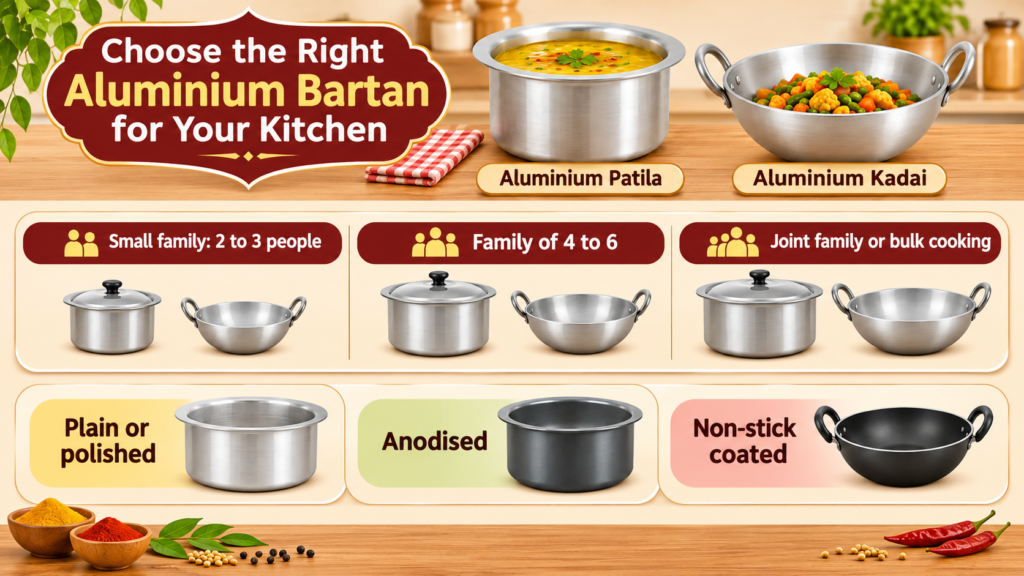
When you shop for aluminium bartan you will see several finishes, and each suits a different purpose.
The finish of aluminium bartan affects how the surface performs during cooking and how much maintenance it requires.
Plain or polished aluminium is the traditional option. It is affordable and heats fast, but it is the most reactive and the easiest to scratch.
Anodised aluminium has a hardened surface layer that resists scratches and is less reactive than plain metal. It usually lasts longer and is easier to maintain.
Non-stick coated aluminium is popular for dosa tawas and kadais that need minimal oil. The base is aluminium, but the coating changes how you care for it: avoid metal spoons and harsh scrubbing.
Choose the finish based on how you cook. If you mostly boil and make dal, a plain or anodised aluminium patila is fine. If you want low-oil cooking, a coated aluminium kadai may suit you better.
Match Aluminium to the Right Kind of Cooking
Aluminium is not ideal for everything, and knowing the limits will protect both your food and your vessel.
Aluminium reacts with strongly acidic or very salty ingredients. Cooking tamarind-based dishes, tomato-heavy gravies or lemon-rich recipes for a long time in plain aluminium can change the taste and discolour the vessel. It is better to cook such dishes in steel, cast iron or a coated vessel, and to avoid storing them in aluminium bartan for long hours.
It works beautifully for boiling water, milk and rice, for making dal and plain sabzi, for deep-frying and for quick sautéing. A good aluminium kadai is perfect for pakoras, puris and dry vegetable preparations.
Also keep in mind that plain aluminium does not work on induction cooktops, because it is not magnetic. If you use induction, look for a vessel with a special induction-compatible base, or choose another material. Always check this before you buy.
Check Quality Marks and Seller Details
Because aluminium is easy to recycle, poor-quality products made from low-grade scrap do exist in the market. To avoid them:
- Buy aluminium bartan labelled as food-grade.
- Look for brand name, material details and proper labelling on the product or packaging.
- Prefer sellers who give clear specifications such as capacity, thickness and finish.
- Read reviews that mention how the vessel held up after months of use, not just on the first day.
If the price seems far lower than similar items from reputable brands, be careful. In cookware, the cheapest option is often the one you replace first.
Choose the Right Size
Capacity is easy to get wrong. An aluminium patila that is too small forces you to cook in batches, while one that is too large wastes gas and storage space.
Choosing aluminium bartan according to your household size helps ensure that your vessels are practical for regular cooking rather than unnecessarily large or small.
- Small family (2 to 3 people): a medium patila for daily dal and rice, plus a small kadai.
- Family of 4 to 6: a larger patila and a medium to large kadai cover most meals.
- Joint family or occasional bulk cooking: a big aluminium patila and a deep, wide kadai will save you a lot of effort.
When in doubt, pick the size you will use daily rather than the size you need once a year.
How to Care for Your Aluminium Bartan
Good care can double the life of your vessels:
Taking care of aluminium bartan regularly also helps maintain its appearance and cooking performance over time.
- Wash with a soft sponge and mild dish soap. Avoid steel scrubbers on anodised and coated pieces.
- Do not leave food sitting in the vessel for long, especially sour or salty dishes.
- Let the vessel cool before washing to prevent warping.
- Dry it fully after washing to avoid dull marks.
- Do not use very high flame with an empty aluminium kadai, as thin metal can warp quickly.
If your plain aluminium patila turns dark, boiling water with a little lemon peel or a spoon of vinegar for a few minutes can lighten the stains.
Final Checklist Before You Buy
Before you add any aluminium bartan to your cart, run through this short list:
- Is the thickness suitable for how I cook?
- Is the base flat and sturdy?
- Are the handles firmly attached, and does the lid fit well?
- Is the surface smooth and free of flaws?
- Is the finish right for my style of cooking?
- Is it food-grade, and does it work with my stove or induction?
- Is the size right for my family?
An aluminium patila and kadai can serve your kitchen faithfully for many years when you choose carefully. Spend a few extra minutes checking these points, and you will end up with aluminium bartan that cooks evenly, lasts longer and gives you better value for your money.
Ready to build your set? Browse the range of cookware at Cookwarekart and pick the aluminium patila and aluminium kadai that suit your kitchen.